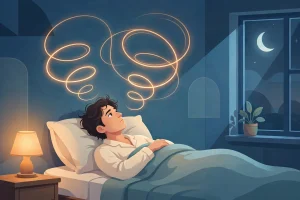
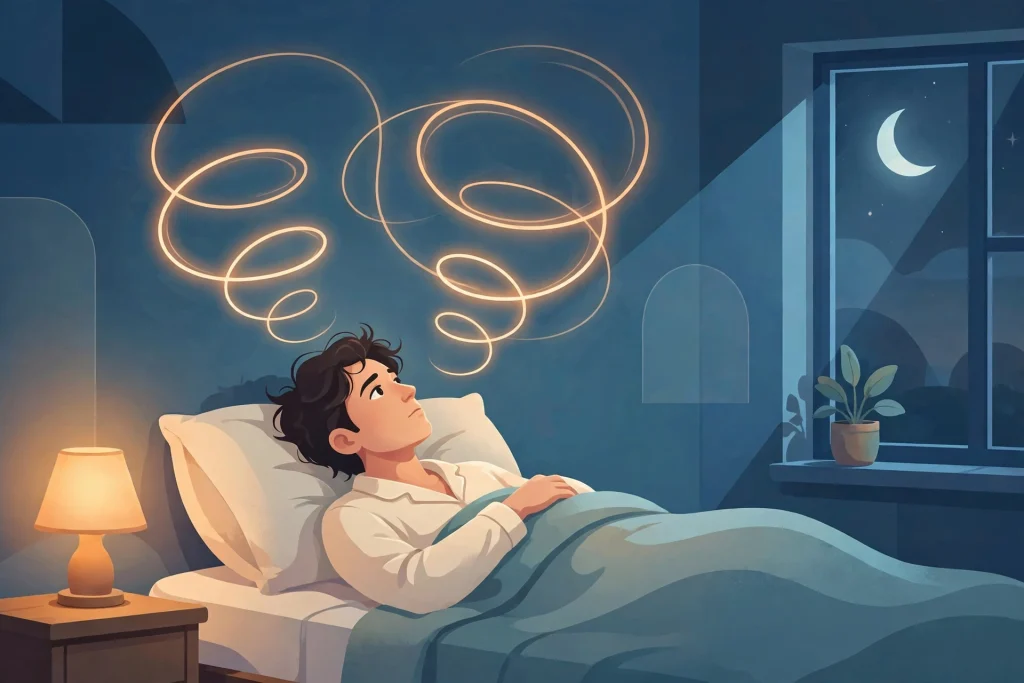
In mental health, rumination means replaying the same upsetting thoughts over and over: a mistake, a conversation, a loss, or how bad you feel. (The word comes from the way cows re-chew food.) Rumination can feel like you are working something out, but it rarely leads anywhere. This guide explains why your mind gets stuck, how rumination differs from worry and OCD, and what actually helps.
What Rumination Means in Mental Health
Psychologists define rumination as repetitive, passive focus on your distress and on its possible causes and consequences, without moving toward action. The key word is passive. You turn the problem over again and again, but you do not make a plan, take a step, or reach a conclusion that settles it.
Rumination is not a diagnosis on its own. It is a thinking pattern that shows up across many conditions, and research by psychologist Susan Nolen-Hoeksema and colleagues found that it worsens depression, makes negative thinking stronger, interferes with problem-solving, and wears down social support.
How Rumination Differs From Worry, Reflection, and OCD
Worry and rumination usually differ in time focus
As a general pattern, worry leans toward the future (picturing losing your job), while rumination leans toward the past (asking why you said something). This is a tendency, not a rule. Rumination often centers on the present too, such as how bad you feel right now or a situation you feel stuck in. The classic research definition of depressive rumination is a focus on your current symptoms of distress and what they mean.
The two also overlap heavily as forms of repetitive negative thinking. Worry is central to generalized anxiety disorder (GAD), while rumination has been studied most in depression.
Brooding is not the same as healthy reflection
Not all repeated thinking is harmful. A 2003 analysis by Treynor, Gonzalez, and Nolen-Hoeksema split rumination into two parts: brooding (passive, gloomy dwelling on what is wrong) and reflective pondering (actively looking into a problem to understand or solve it). Brooding is the part most closely tied to depression.
Researcher Edward Watkins found that style matters as much as content. In his review of constructive and unconstructive repetitive thought, abstract "why" thinking (causes, meanings, what it says about you) slowed emotional recovery and hurt problem-solving, while concrete "how" thinking (what happened, what to do next) helped.
Rumination in OCD works differently
In obsessive-compulsive disorder, rumination often acts as a compulsion. The International OCD Foundation describes compulsions as behaviors or "mental acts", including mental reviewing, that people use to neutralize an unwanted thought. Someone might replay a conversation for hours to prove they did not offend anyone, or analyze an intrusive thought to make sure it does not "mean" something about them.
Depressive rumination tends to center on loss and self-blame, while OCD mental review tends to be driven by a need for certainty and brings short relief that keeps the cycle going. The two can overlap, and it is common for people with OCD to also have a mood or anxiety disorder.
The table below shows general patterns, not diagnostic rules, and many people have features of more than one.
| Feature | Worry | Rumination | OCD mental review |
|---|---|---|---|
| Main time focus (general pattern) | The future | The past and present | Any time, tied to an obsession |
| Typical content | What might go wrong | Mistakes, losses, how bad you feel | An intrusive thought or a doubt to settle |
| What it feels like | Tense, "what if" | Heavy, stuck, "why" or "if only" | Urgent, like a task you must finish |
| What it tries to do | Prepare for or prevent a threat | Understand or fix distress | Gain certainty or neutralize the thought |
| What usually helps | CBT, worry postponement, anxiety treatment | RFCBT, MCT, MBCT, behavioral activation | Exposure and response prevention, serotonin reuptake inhibitors |
Telling these patterns apart takes an individual assessment by a clinician, so you do not need to sort it out on your own. If your thinking feels driven or like something you have to finish, describe that to your clinician, because it can change which treatment fits.
What Ruminating Thoughts Look Like Day to Day
The habit is easy to miss because it feels like ordinary thinking. Common signs include:
- Replaying a conversation and rewriting what you should have said
- Going over a past mistake long after anyone else has moved on
- Asking yourself why you feel this way, again and again, without an answer
- Lying awake while the same scene plays on repeat
- Talking about a problem with friends for hours without feeling better
- Losing track of work or a show because your mind keeps drifting back
What Causes a Person to Ruminate
Several forces keep the mind stuck:
- Threat detection. Your brain treats unresolved problems as possible dangers and keeps pulling attention back to them.
- Unfinished goals. Goal progress theory describes rumination as recurring thought about important goals that have not been reached. A breakup, a job loss, or a falling-out can keep the loop open.
- Very high standards. People who hold themselves to rigid, all-or-nothing standards tend to review every flaw.
- Avoidance. Replaying a problem can stand in for hard actions or feelings. It feels productive, so it can replace the call you need to make.
- Beliefs about thinking. Many people believe that analyzing their sadness will produce an answer. Metacognitive researchers call this a positive belief about rumination, and it keeps the habit going.
- Trauma and ongoing stress. Painful past events and stressors you cannot control give the mind more material to replay.
Conditions Linked With Rumination
Rumination is transdiagnostic, meaning it shows up across many conditions:
- Depression. Rumination more consistently predicts when depression begins than how long it lasts, and it deepens low mood once it starts. It can also hide behind outward success, as in high-functioning depression, when someone keeps functioning while replaying failures in private.
- Anxiety and GAD. Rumination anxiety often looks like replaying events and dreading what they mean. In social anxiety, people often replay social interactions afterward and focus on what went wrong.
- OCD. Mental review, as described above.
- PTSD. People with PTSD report more trauma-related thoughts before sleep than people with depression or insomnia alone.
- ADHD. A 2023 study of 159 adults with ADHD found that rumination and excessive mind wandering helped explain the link between ADHD symptoms and anxiety and depression. Overthinking a task instead of starting it can also feed the freeze known as ADHD paralysis. Some people also describe intense pain after perceived criticism, often called rejection sensitive dysphoria, and replay the moment for days.
- Bipolar disorder. A 2015 systematic review found rumination in all phases of bipolar disorder, including between episodes, and in response to both positive and negative moods.
- Premenstrual flares. In a 2023 daily-diary study, worse late luteal (premenstrual) symptoms predicted more rumination the same day. If your thought loops spike before your period, PMDD treatment may be worth discussing.
Effects on Sleep, Mood, and Physical Health
Repetitive thinking is linked to insomnia, and sleep loss makes the next day's mood and focus worse, which feeds the loop. A 2016 meta-analysis of worry and rumination found associations with higher heart rate, lower heart rate variability, and higher cortisol, plus higher blood pressure in experimental studies. A review of rumination and physical health also links it to more noticeable physical symptoms, although the authors note the mechanism is not fully understood.
Evidence-Based Treatments for Rumination
Rumination-focused CBT
Rumination-focused cognitive behavioral therapy (RFCBT) teaches you to spot the start of a rumination loop and practice concrete "how" thinking instead. In a small 2011 UK trial of 42 adults whose depression had only partly responded to antidepressants, adding RFCBT to usual care led to remission in 62 percent, versus 21 percent with usual care alone. This early study shows promise, not a result every person should expect.
Metacognitive therapy
Metacognitive therapy (MCT) does not argue with the content of your thoughts. It targets beliefs about thinking, such as "ruminating will give me answers" or "I cannot control my thoughts," and uses techniques like attention training, detached mindfulness, and postponing rumination. In a 2017 randomized trial of MCT for depression, about 70 to 80 percent of 39 adults at a Norwegian university clinic recovered after 10 sessions, versus very few on a waiting list. With a small sample and no comparison therapy, these results are not what every person should expect.
Mindfulness-based cognitive therapy
Mindfulness-based cognitive therapy (MBCT) trains you to notice thoughts as passing events instead of facts. A 2016 analysis pooling patient data from nine randomized trials found MBCT helps prevent the return of major depression in people who are currently in remission.
Behavioral activation
Behavioral activation treats rumination as a form of avoidance. Instead of debating your thoughts, you schedule activities tied to what you value and what you have been avoiding. Therapists also help you turn "why" and "if only" questions into "how" questions that lead to a next step.
How to Stop Ruminating: Practical Techniques and Why They Work
These skills come from the treatments above and work best with practice.
- Set a postponement window. This technique comes from worry postponement and metacognitive therapy. Pick a short, fixed time each day, and when a loop starts outside it, note the thought and save it for then. The direct evidence was gathered on worry: a 2024 trial found a two-session postponement program reduced worry in adults with GAD. Therapists often adapt it for rumination to show you have more control over when you engage.
- Switch from "why" to "how." Instead of asking why this always happens to you, ask how you will handle the next step. Concrete questions point toward action.
- Use distraction that absorbs attention. Experimental studies show positive distraction improves low mood. Pick something that needs your full focus, such as a puzzle, a conversation, or a new recipe. Scrolling usually does not count.
- Take one behavioral next step. Send the email, make the apology, or write the first line of the plan. Action closes the open loop that rumination keeps circling.
- Practice mindfulness noting. When you notice the loop, silently label it "thinking" or "replaying," then return to your breath or the task in front of you. You are not trying to stop the thought, only to step back from it.
When to See a Psychiatrist About Rumination
Self-help skills are a good start, but a loop that will not budge often points to a condition worth evaluating. Consider booking a visit if:
- It keeps you up at night or steals hours from work or school
- It comes with low mood, loss of interest, or constant anxiety
- Your thinking feels like a ritual you must complete, or you have other compulsions
- You notice periods of unusually high energy or little need for sleep
- You feel hopeless or have thoughts of death
If dread and constant worry drive most of your loops, these signs it is time to see a psychiatrist for anxiety may also apply.
If you are in crisis or thinking about harming yourself, call or text 988 (Suicide and Crisis Lifeline). If there is immediate danger, call 911.
Medication does not target rumination by itself, but treating the underlying condition often quiets it. SSRI and SNRI antidepressants are commonly used for depression and GAD, and serotonin reuptake inhibitors are a standard treatment for OCD. Many people do best with medication management combined with therapy. If you already take medication, talk with your prescriber before making any change. You can read more about options for depression treatment and anxiety treatment.
Frequently Asked Questions About Rumination
What is rumination in mental health?
In mental health, rumination is repetitive, passive focus on your distress and its causes and consequences, without moving toward a solution. It is different from the animal meaning of the word, where cows re-chew their food. Rumination is not a diagnosis by itself. It is a thinking pattern that shows up in depression, anxiety, OCD, and other conditions.
How do you stop ruminating?
You stop ruminating by interrupting the loop and redirecting your attention, not by forcing the thought away. Helpful skills include switching from why questions to how questions, setting a daily postponement window, using absorbing distraction, and taking one small action on the problem. If the loop persists, therapy and treatment of any underlying condition can help.
How do you stop ruminating at night?
To stop ruminating at night, give your thoughts a set time earlier in the day so they are not saved for bedtime. Writing down what is on your mind and one next step before bed can help close the loop. If you cannot sleep, get up and do something calm in dim light until you feel sleepy.
What causes rumination?
Rumination is usually caused by a mix of factors rather than one source. Common drivers include unresolved goals or losses, very high standards, avoidance of hard actions or feelings, the belief that analyzing distress will produce answers, and trauma or ongoing stress. Depression, anxiety, OCD, and PTSD can also make it more frequent and harder to stop.
Is rumination the same as overthinking?
Rumination is one type of overthinking, but not all overthinking is rumination. Overthinking is an everyday term for thinking too much about something. Rumination specifically means passively dwelling on distress, its causes, and what it means, usually without reaching a plan. Worry, which tends to focus on what might go wrong, is another common type.
Is rumination a sign of OCD?
Rumination alone is not a sign of OCD, because it also occurs in depression, anxiety, and other conditions. In OCD, though, it often works as a mental compulsion, such as reviewing a memory to feel certain or to neutralize an intrusive thought. A clinician can tell which pattern fits, which matters because OCD is usually treated with exposure and response prevention.
Can medication help stop rumination?
Medication does not target rumination directly, but treating the condition behind it often quiets the loop. SSRIs and SNRIs are commonly used for depression and generalized anxiety disorder, and serotonin reuptake inhibitors are a standard treatment for OCD. Many people do best with medication plus therapy. If you already take medication, talk with your prescriber before making any change.
Is rumination the same as rumination syndrome?
No, rumination syndrome is a separate condition in which recently eaten food comes back up into the mouth without effort and is then rechewed and swallowed or spit out. It is not vomiting and is not preceded by nausea. Sometimes called rumination disorder, it is assessed by a medical clinician, often a gastroenterologist, and is usually treated with diaphragmatic breathing.
Get Help in New York, New Jersey, or Pennsylvania
Rumination is a pattern, not a diagnosis, so the first step is finding out what drives it. A psychiatric evaluation reviews your symptoms, history, and daily life, and checks for conditions that often fuel repetitive thinking, including anxiety, OCD, depression, bipolar disorder, ADHD, and premenstrual mood disorders. It also covers sleep, since poor sleep and rumination feed each other. From there, you and the psychiatrist can decide if medication, therapy, or both make sense.
Adults, teens, and children in New York, New Jersey, and Pennsylvania can book a free 15-minute telehealth consultation with a board-certified psychiatrist to talk through next steps.